Friends,
There is an urgent call for prayer in Turkey. Read the open letter sent to all protestant churches.
Several of our brothers have been martyred, and there is expected to be more persecution and strife for the Christians in Turkey. They have asked for all of us to pray for the perseverance of their faith.
May grace abound as we glorify Christ together, even amidst these tragic times.
Will.
Monday, April 30, 2007


Wednesday, April 25, 2007
Run to the Battle
Acts 13:4-12
(Message given at Faith Church on April 22, 2007, 1:30pm)
INTRODUCTION
What we see in today’s passage are two people called by God and sent by the Holy Spirit to RUN TO THE BATTLE.
What I mean by that is first, “RUN.” We see Barnabas and Saul not milling around thinking about “should I or shouldn’t I.” They are not taking their sweet time making sure all their affairs are in order. Figuratively, they were not walking. They were running.
And they were running “TO.” We see them not running away from or running around. They knew where they had to go and so they ran “TO.”
And they were running to “THE BATTLE.” As you will see, they knew exactly what they were running to. They knew the heartaches and the hardships. They knew that they were running into “THE BATTLE.”
That is why today’s message is titled “Run to the Battle.” I am going to unpack today’s passage but before we go through them, I want you to clearly understand what I believe.
I believe all of you who profess to be a Christian, if God has truly called you into a saving faith, with that you are also called to run to the battle. To be people who live out their earthly lives going where God calls them to go, doing whatever God calls them to do.
So I believe Sideline Christian is an oxymoron. There is no bench warming. There is no just watching the battle for true Christians.
Therefore, when I say run to the battle. I am just merely describing what a God-glorifying, Jesus loving Spirit-empowering life looks like. I am not “suggesting” that you run to the battle as if I am saying that it is an option for us to take or not take. This is the life of a Christ-follower.
I just wanted you to know what I believe. Now, some body here might say, “But Sean, I am struggling. I believe I am a Christian, but I don’t see my life as running into the battle. Nor do I even want to.” “How do I make my heart want to run to the battle?” To that, let me answer this way.
You cannot make your heart want to do something. You can force your body to do something but not your heart.
But here is what you can do. Do what Barnabas, Saul, and the other people were doing in verses 1-3.
Now there were in the church at Antioch prophets and teachers, Barnabas, Simeon who was called Niger, Lucius of Cyrene, Manaen a member of the court of Herod the tetrarch, and Saul. While they were worshiping the Lord and fasting, the Holy Spirit said, “Set apart for me Barnabas and Saul for the work to which I have called them.” Then after fasting and praying they laid their hands on them and sent them off. Acts 13:1-3 (ESV)
Love God, worship God, be with God, seek God, pray and ask others to pray for you, and etc. And not because you have earned it but because of His grace, what will happen is that the Holy Spirit will minister and reveal to you how beautiful and glorious God is.
Then, and only then, you will want to run to the battle. In fact, no one can stop you.
Let’s unpack today’s passage. And we are going to see four things about running into the battle. First, we see that Barnabas and Saul are running into a …
1. Great Mission (Vs. 4-5)
So, being sent out by the Holy Spirit, they went down to Seleucia, and from there they sailed to Cyprus. When they arrived at Salamis, they proclaimed the word of God in the synagogues of the Jews. And they had John to assist them. Acts 13:4-5 (ESV)
In Acts 13:4 we read that Barnabas and Saul were sent on their way by the Holy Spirit. Not only were they sent by the church, but they were also sent by the Holy Spirit. This is an important point. Human leaders may lead us into ministries and places, but if the Holy Spirit does not lead us, we will fail. Conversely, when the Holy Spirit sends us, he goes with us, for Jesus Christ said, “And surely I am with you always, to the very end of the age.”
No matter what ministry we are called to, we must not focus on whether or not we have the know-how, the resources, or whatever we think we need. Rather, we need to focus on whether or not the Holy Spirit is leading us. If the Holy Spirit is with us, he will take care of all our needs. God will accomplish what He needs to accomplish.
However, that does not mean that we sit and twiddle our thumbs. The Spirit of God sends us out. He does not drag us or deceive us, but sends us by calling. And look at the next part of the verse.
So, being sent out by the Holy Spirit, they went down to Seleucia, and from there they sailed to Cyprus. When they arrived at Salamis, they proclaimed the word of God in the synagogues of the Jews. And they had John to assist them. Acts 13:4-5 (ESV)
They went; they sailed. In other words, they obeyed.
Now, we could just say, “cool.” But we must look at where they went. Where did they go?

Antioch to Port city of Seleucia – 15 miles. Sailed Seleucia to Cyprus. They arrived in the port city of Salamis. Cyprus was a province of Rome, ruled by a senatorial proconsul beginning in 22 B.C.
Cyprus was known as the isle of commerce. Very busy island because of its location. It was a shipping lane between Syria, Asia Minor, and Greece. It was also a trade center of many things.
However Cyprus was also known as the isle of happiness. Why, you might ask. On the one hand, it was because of great weather and other abundance the residents and travelers enjoyed. On the other hand, the island was known for temple prostitutes. There was a temple of Aphrodite, or Venus in the capital city of Paphos where people could engage in cultic prostitution. Ironically, one of the nicknames for Cyprus was, “the Happy Isle.”
Before Barnabas and Saul went to Cyprus, do you think they knew where they were running into? Of course they did. Because Barnabas was from Cyprus.
So when they knew that God was leading them to Cyprus, they must have thought, “God, are you sure.” We must see that their obedience to God included clearly knowing where and what they were running into.
And they also clearly knew what their mission was.
So, being sent out by the Holy Spirit, they went down to Seleucia, and from there they sailed to Cyprus. When they arrived at Salamis, they proclaimed the word of God in the synagogues of the Jews. And they had John to assist them. Acts 13:4-5 (ESV)
They did not go there for a sunny holiday. They did not go there to do some commerce. They definitely did not go to Cyprus to “hang out” at the temple.
Into this place of deep moral darkness, Barnabas and Saul went to shine the light of the gospel. Into this place where pleasure is proclaimed to the number one goal, they went to proclaim the Word of God.
This was a great mission and brothers and sisters in Christ, God too has called us to this same great mission. However, with great mission, there is always …
2. Grim Opposition (Vs. 6-8)
When they had gone through the whole island as far as Paphos, they came upon a certain magician, a Jewish false prophet named Bar-Jesus. He was with the proconsul, Sergius Paulus, a man of intelligence, who summoned Barnabas and Saul and sought to hear the word of God. But Elymas the magician (for that is the meaning of his name) opposed them, seeking to turn the proconsul away from the faith. Acts 13:6-8 (ESV)
In Paphos the missionaries met the Jewish sorcerer and false prophet Bar-Jesus. This guy was not a clown doing a magic show at a kid’s birthday party. Bar-Jesus was a well-known sorcerer. Who worked for the proconsul (like a mayor), Sergius Paulus.
The Bible says Sergius Paulus was a very intelligent man and it seems to me that he was thoroughly dissatisfied by the trickery, hollow philosophies and deceit of these retainers. This prominent Roman official invited the missionaries to preach the word of God to him.
At this point Saul and Barnabas began to experience serious opposition in their missionary venture. There will always be opposition, inspired by Satan, in the world against the gospel.
This opposition came through Bar-Jesus. Bar-Jesus means “son of salvation” or “son of Jesus.” But Bar-Jesus had another name, Elymas, which means “skillful one,” or “sorcerer.” As we just said, Bar-Jesus was a Jewish magician and false prophet, a man who pretended to be a source of divine revelation.
It seems like Luke writing this account wants the reader to know that this magician says he is Bar-Jesus but his real name is Elymas.
History had always had false prophets. We see such false prophets throughout the history of Israel, such as the four hundred false prophets of Baal who stood against the prophet Elijah. Jesus warned against false prophets.
“Beware of false prophets, who come to you in sheep's clothing but inwardly are ravenous wolves.” Matthew 7:15 (ESV)
As an attendant of Sergius Paulus, Bar-Jesus knew he could lose his income if Sergius Paulus became a Christian, so he began to vigorously oppose the missionaries and tried to turn the proconsul from the gospel.
In our obedience to the Spirit of God, there will always be opposition. Opposition that may even seem grim. As we move forward, … Not enough money, not enough people pitching in, not enough of this or that.
This is very much the situation in our lives. There is always temptation to be down about our situation. That is not the Spirit of God speaking but another spirit.
Here is the Good News. No matter how grim the opposition might be, we have the …
3. Greatest Power (Vs. 9-11)
Because we have a great God who sends us out on a great mission. And with that we have the Holy Spirit.
Little children, you are from God and have overcome them, for he who is in you is greater than he who is in the world. 1 John 4:4 (ESV)
In the midst of what may seem like a grim opposition, the Holy Spirit came upon Paul. God’s Spirit will always come upon you the moment you need him, energizing you, guiding you and making you competent to meet the opposition. Filled with the Holy Spirit, Paul took charge of the situation.
But Saul, who was also called Paul, filled with the Holy Spirit, looked intently at him and said, "You son of the devil, you enemy of all righteousness, full of all deceit and villainy, will you not stop making crooked the straight paths of the Lord? And now, behold, the hand of the Lord is upon you, and you will be blind and unable to see the sun for a time." Immediately mist and darkness fell upon him, and he went about seeking people to lead him by the hand. Acts 13:9-11 (ESV)
First, Paul said, “You are a child of the devil,” or in the Greek, “a son of the devil.” In other words, the Holy Spirit was saying, “Bar-Jesus, despite your name, you are no son of Jesus. You are no son of salvation. You are a son of the devil!” Then he said, “You are an enemy of everything that is right.” Next he said, “You are full of all kinds of deceit and trickery. Will you never stop perverting the right ways of the Lord?”
How can we know if someone is a false prophet?
Beloved, do not believe every spirit, but test the spirits to see whether they are from God, for many false prophets have gone out into the world. By this you know the Spirit of God: every spirit that confesses that Jesus Christ has come in the flesh is from God, and every spirit that does not confess Jesus is not from God. This is the spirit of the antichrist, which you heard was coming and now is in the world already. Little children, you are from God and have overcome them, for he who is in you is greater than he who is in the world. 1 John 4:1-4 (ESV)
How can we know? Ask your selves, is Jesus the central message? Is the gospel of Jesus Christ the central message? Is Jesus the hero?
I am usually not overly concerned about cults because they are very obvious. But concern that I seem to have is when a Bible teacher or preacher stands and do not preach the gospel as recorded in God’s word.
Spirit through Paul and John says they are the sons of the devil, enemies of righteousness, perverters of the straight ways of God. (say this softly, humbly, and regrettably)
Every false prophet, every cult member, and every preacher who refuses to preach the gospel as given to us in the word of God, is rejected by God.
Just as Bar-Jesus was full of evil spirits, deceit, and trickery, Paul and Barnabas were full of the Holy Spirit and the gospel. The Holy Spirit empowered them to deal with the lies of Satan and his demonic power as manifested by Bar-Jesus.
The Holy Spirit came upon Paul, not to bless Bar-Jesus, but to curse him. Paul pronounced a curse, and Bar-Jesus was instantly blinded and totally defeated. Verse 11 tells us, “Immediately mist and darkness fell upon him, and he went about seeking people to lead him by the hand.”
Ironically, God blinds Elymas because he has been blinding others.
This was the triumph of the gospel over the lies of Satan, the triumph of the Holy Spirit over evil spirits, and the triumph of Christ over Satan in Cyprus.
4. Glorious Faith (Vs. 12)
Then the proconsul believed, when he saw what had occurred, for he was astonished at the teaching of the Lord. Acts 13:12 (ESV)
The proconsul believed; “Pisteuo.”
With Bar-Jesus out of the way, Sergius Paulus could hear the gospel without hindrance and he believed in Jesus Christ.
I say GLORIOUS faith because this faith was made possible because of the Spirit of God. It was God who planned this. It was God who did this.
And I say glorious FAITH because through faith in Jesus Christ, He is glorified. So through Barnabas and Saul’s faith there were others who also came to faith. The will of God is that, through our faith, others will come to know Jesus as well. And humbly, maybe the will of God be that through our faith family, others in the Willowdale community will come to know Jesus as well.
What About You?
The gospel tells us to repent and believe on the Lord Jesus Christ and we shall be saved. Would you do that today? Would you put away the idols of your heart – the stubbornness, the arrogance, the pride, the twistedness, the self-centeredness – and give your life over to Jesus Christ to serve him with all your heart, mind, soul and strength?
It is my prayer that you will be like Sergius Paulus – this intelligent man who welcomed the missionaries and their message. He realized the emptiness of all the trickery, the mystery religions and the philosophies offered by the world. By the grace of God, he was looking for something and he found the gospel of Jesus Christ.
And will you join us in running into the battle? Will you run to the battle?
The title of the sermon is taken from an old song that I use to listen to. As we close today, let me read (not sing) it for us and then I will pray.
RUN TO THE BATTLE
(Steve Camp)
Some people want to live
Within the sound of chapel bells
But I want to run a mission
A yard from the gates of Hell
And with everyone you meet
I'll take them the gospel and share it well
And look around you as you hesitate
For another soul just fell
Let's run to the battle
Run to the battle
Do you have your armor on
We're in the middle of a raging war
We've been training for so long
Have we learned to use His sword?
We may not be ready
But we serve a mighty Lord
And He's made us more than conquerors
So what are you waiting for?
Let's run to the battle
We got to run, run to the battle
He has trampled down the enemy
And has given us the victory
When we pray we learn to see
That His army
We are marching on our knees
There'll be times when we grow weak
Let's keep our faith alive
Let your faces shine with glory
For He's helped us to survive
And in that final hour
When you feel like you're ready to die
Will you hear the trumpet sound
Will you hear the warrior cry
Run to the battle
We got to run, run to the battle
Steve Camp
© 1981 Word Music (a div. of Word, Inc.)(ASCAP)
(Message given at Faith Church on April 22, 2007, 1:30pm)
INTRODUCTION
What we see in today’s passage are two people called by God and sent by the Holy Spirit to RUN TO THE BATTLE.
What I mean by that is first, “RUN.” We see Barnabas and Saul not milling around thinking about “should I or shouldn’t I.” They are not taking their sweet time making sure all their affairs are in order. Figuratively, they were not walking. They were running.
And they were running “TO.” We see them not running away from or running around. They knew where they had to go and so they ran “TO.”
And they were running to “THE BATTLE.” As you will see, they knew exactly what they were running to. They knew the heartaches and the hardships. They knew that they were running into “THE BATTLE.”
That is why today’s message is titled “Run to the Battle.” I am going to unpack today’s passage but before we go through them, I want you to clearly understand what I believe.
I believe all of you who profess to be a Christian, if God has truly called you into a saving faith, with that you are also called to run to the battle. To be people who live out their earthly lives going where God calls them to go, doing whatever God calls them to do.
So I believe Sideline Christian is an oxymoron. There is no bench warming. There is no just watching the battle for true Christians.
Therefore, when I say run to the battle. I am just merely describing what a God-glorifying, Jesus loving Spirit-empowering life looks like. I am not “suggesting” that you run to the battle as if I am saying that it is an option for us to take or not take. This is the life of a Christ-follower.
I just wanted you to know what I believe. Now, some body here might say, “But Sean, I am struggling. I believe I am a Christian, but I don’t see my life as running into the battle. Nor do I even want to.” “How do I make my heart want to run to the battle?” To that, let me answer this way.
You cannot make your heart want to do something. You can force your body to do something but not your heart.
But here is what you can do. Do what Barnabas, Saul, and the other people were doing in verses 1-3.
Now there were in the church at Antioch prophets and teachers, Barnabas, Simeon who was called Niger, Lucius of Cyrene, Manaen a member of the court of Herod the tetrarch, and Saul. While they were worshiping the Lord and fasting, the Holy Spirit said, “Set apart for me Barnabas and Saul for the work to which I have called them.” Then after fasting and praying they laid their hands on them and sent them off. Acts 13:1-3 (ESV)
Love God, worship God, be with God, seek God, pray and ask others to pray for you, and etc. And not because you have earned it but because of His grace, what will happen is that the Holy Spirit will minister and reveal to you how beautiful and glorious God is.
Then, and only then, you will want to run to the battle. In fact, no one can stop you.
Let’s unpack today’s passage. And we are going to see four things about running into the battle. First, we see that Barnabas and Saul are running into a …
1. Great Mission (Vs. 4-5)
So, being sent out by the Holy Spirit, they went down to Seleucia, and from there they sailed to Cyprus. When they arrived at Salamis, they proclaimed the word of God in the synagogues of the Jews. And they had John to assist them. Acts 13:4-5 (ESV)
In Acts 13:4 we read that Barnabas and Saul were sent on their way by the Holy Spirit. Not only were they sent by the church, but they were also sent by the Holy Spirit. This is an important point. Human leaders may lead us into ministries and places, but if the Holy Spirit does not lead us, we will fail. Conversely, when the Holy Spirit sends us, he goes with us, for Jesus Christ said, “And surely I am with you always, to the very end of the age.”
No matter what ministry we are called to, we must not focus on whether or not we have the know-how, the resources, or whatever we think we need. Rather, we need to focus on whether or not the Holy Spirit is leading us. If the Holy Spirit is with us, he will take care of all our needs. God will accomplish what He needs to accomplish.
However, that does not mean that we sit and twiddle our thumbs. The Spirit of God sends us out. He does not drag us or deceive us, but sends us by calling. And look at the next part of the verse.
So, being sent out by the Holy Spirit, they went down to Seleucia, and from there they sailed to Cyprus. When they arrived at Salamis, they proclaimed the word of God in the synagogues of the Jews. And they had John to assist them. Acts 13:4-5 (ESV)
They went; they sailed. In other words, they obeyed.
Now, we could just say, “cool.” But we must look at where they went. Where did they go?

Cyprus was known as the isle of commerce. Very busy island because of its location. It was a shipping lane between Syria, Asia Minor, and Greece. It was also a trade center of many things.
However Cyprus was also known as the isle of happiness. Why, you might ask. On the one hand, it was because of great weather and other abundance the residents and travelers enjoyed. On the other hand, the island was known for temple prostitutes. There was a temple of Aphrodite, or Venus in the capital city of Paphos where people could engage in cultic prostitution. Ironically, one of the nicknames for Cyprus was, “the Happy Isle.”
Before Barnabas and Saul went to Cyprus, do you think they knew where they were running into? Of course they did. Because Barnabas was from Cyprus.
So when they knew that God was leading them to Cyprus, they must have thought, “God, are you sure.” We must see that their obedience to God included clearly knowing where and what they were running into.
And they also clearly knew what their mission was.
So, being sent out by the Holy Spirit, they went down to Seleucia, and from there they sailed to Cyprus. When they arrived at Salamis, they proclaimed the word of God in the synagogues of the Jews. And they had John to assist them. Acts 13:4-5 (ESV)
They did not go there for a sunny holiday. They did not go there to do some commerce. They definitely did not go to Cyprus to “hang out” at the temple.
Into this place of deep moral darkness, Barnabas and Saul went to shine the light of the gospel. Into this place where pleasure is proclaimed to the number one goal, they went to proclaim the Word of God.
This was a great mission and brothers and sisters in Christ, God too has called us to this same great mission. However, with great mission, there is always …
2. Grim Opposition (Vs. 6-8)
When they had gone through the whole island as far as Paphos, they came upon a certain magician, a Jewish false prophet named Bar-Jesus. He was with the proconsul, Sergius Paulus, a man of intelligence, who summoned Barnabas and Saul and sought to hear the word of God. But Elymas the magician (for that is the meaning of his name) opposed them, seeking to turn the proconsul away from the faith. Acts 13:6-8 (ESV)
In Paphos the missionaries met the Jewish sorcerer and false prophet Bar-Jesus. This guy was not a clown doing a magic show at a kid’s birthday party. Bar-Jesus was a well-known sorcerer. Who worked for the proconsul (like a mayor), Sergius Paulus.
The Bible says Sergius Paulus was a very intelligent man and it seems to me that he was thoroughly dissatisfied by the trickery, hollow philosophies and deceit of these retainers. This prominent Roman official invited the missionaries to preach the word of God to him.
At this point Saul and Barnabas began to experience serious opposition in their missionary venture. There will always be opposition, inspired by Satan, in the world against the gospel.
This opposition came through Bar-Jesus. Bar-Jesus means “son of salvation” or “son of Jesus.” But Bar-Jesus had another name, Elymas, which means “skillful one,” or “sorcerer.” As we just said, Bar-Jesus was a Jewish magician and false prophet, a man who pretended to be a source of divine revelation.
It seems like Luke writing this account wants the reader to know that this magician says he is Bar-Jesus but his real name is Elymas.
History had always had false prophets. We see such false prophets throughout the history of Israel, such as the four hundred false prophets of Baal who stood against the prophet Elijah. Jesus warned against false prophets.
“Beware of false prophets, who come to you in sheep's clothing but inwardly are ravenous wolves.” Matthew 7:15 (ESV)
As an attendant of Sergius Paulus, Bar-Jesus knew he could lose his income if Sergius Paulus became a Christian, so he began to vigorously oppose the missionaries and tried to turn the proconsul from the gospel.
In our obedience to the Spirit of God, there will always be opposition. Opposition that may even seem grim. As we move forward, … Not enough money, not enough people pitching in, not enough of this or that.
This is very much the situation in our lives. There is always temptation to be down about our situation. That is not the Spirit of God speaking but another spirit.
Here is the Good News. No matter how grim the opposition might be, we have the …
3. Greatest Power (Vs. 9-11)
Because we have a great God who sends us out on a great mission. And with that we have the Holy Spirit.
Little children, you are from God and have overcome them, for he who is in you is greater than he who is in the world. 1 John 4:4 (ESV)
In the midst of what may seem like a grim opposition, the Holy Spirit came upon Paul. God’s Spirit will always come upon you the moment you need him, energizing you, guiding you and making you competent to meet the opposition. Filled with the Holy Spirit, Paul took charge of the situation.
But Saul, who was also called Paul, filled with the Holy Spirit, looked intently at him and said, "You son of the devil, you enemy of all righteousness, full of all deceit and villainy, will you not stop making crooked the straight paths of the Lord? And now, behold, the hand of the Lord is upon you, and you will be blind and unable to see the sun for a time." Immediately mist and darkness fell upon him, and he went about seeking people to lead him by the hand. Acts 13:9-11 (ESV)
First, Paul said, “You are a child of the devil,” or in the Greek, “a son of the devil.” In other words, the Holy Spirit was saying, “Bar-Jesus, despite your name, you are no son of Jesus. You are no son of salvation. You are a son of the devil!” Then he said, “You are an enemy of everything that is right.” Next he said, “You are full of all kinds of deceit and trickery. Will you never stop perverting the right ways of the Lord?”
How can we know if someone is a false prophet?
Beloved, do not believe every spirit, but test the spirits to see whether they are from God, for many false prophets have gone out into the world. By this you know the Spirit of God: every spirit that confesses that Jesus Christ has come in the flesh is from God, and every spirit that does not confess Jesus is not from God. This is the spirit of the antichrist, which you heard was coming and now is in the world already. Little children, you are from God and have overcome them, for he who is in you is greater than he who is in the world. 1 John 4:1-4 (ESV)
How can we know? Ask your selves, is Jesus the central message? Is the gospel of Jesus Christ the central message? Is Jesus the hero?
I am usually not overly concerned about cults because they are very obvious. But concern that I seem to have is when a Bible teacher or preacher stands and do not preach the gospel as recorded in God’s word.
Spirit through Paul and John says they are the sons of the devil, enemies of righteousness, perverters of the straight ways of God. (say this softly, humbly, and regrettably)
Every false prophet, every cult member, and every preacher who refuses to preach the gospel as given to us in the word of God, is rejected by God.
Just as Bar-Jesus was full of evil spirits, deceit, and trickery, Paul and Barnabas were full of the Holy Spirit and the gospel. The Holy Spirit empowered them to deal with the lies of Satan and his demonic power as manifested by Bar-Jesus.
The Holy Spirit came upon Paul, not to bless Bar-Jesus, but to curse him. Paul pronounced a curse, and Bar-Jesus was instantly blinded and totally defeated. Verse 11 tells us, “Immediately mist and darkness fell upon him, and he went about seeking people to lead him by the hand.”
Ironically, God blinds Elymas because he has been blinding others.
This was the triumph of the gospel over the lies of Satan, the triumph of the Holy Spirit over evil spirits, and the triumph of Christ over Satan in Cyprus.
4. Glorious Faith (Vs. 12)
Then the proconsul believed, when he saw what had occurred, for he was astonished at the teaching of the Lord. Acts 13:12 (ESV)
The proconsul believed; “Pisteuo.”
With Bar-Jesus out of the way, Sergius Paulus could hear the gospel without hindrance and he believed in Jesus Christ.
I say GLORIOUS faith because this faith was made possible because of the Spirit of God. It was God who planned this. It was God who did this.
And I say glorious FAITH because through faith in Jesus Christ, He is glorified. So through Barnabas and Saul’s faith there were others who also came to faith. The will of God is that, through our faith, others will come to know Jesus as well. And humbly, maybe the will of God be that through our faith family, others in the Willowdale community will come to know Jesus as well.
What About You?
The gospel tells us to repent and believe on the Lord Jesus Christ and we shall be saved. Would you do that today? Would you put away the idols of your heart – the stubbornness, the arrogance, the pride, the twistedness, the self-centeredness – and give your life over to Jesus Christ to serve him with all your heart, mind, soul and strength?
It is my prayer that you will be like Sergius Paulus – this intelligent man who welcomed the missionaries and their message. He realized the emptiness of all the trickery, the mystery religions and the philosophies offered by the world. By the grace of God, he was looking for something and he found the gospel of Jesus Christ.
And will you join us in running into the battle? Will you run to the battle?
The title of the sermon is taken from an old song that I use to listen to. As we close today, let me read (not sing) it for us and then I will pray.
RUN TO THE BATTLE
(Steve Camp)
Some people want to live
Within the sound of chapel bells
But I want to run a mission
A yard from the gates of Hell
And with everyone you meet
I'll take them the gospel and share it well
And look around you as you hesitate
For another soul just fell
Let's run to the battle
Run to the battle
Do you have your armor on
We're in the middle of a raging war
We've been training for so long
Have we learned to use His sword?
We may not be ready
But we serve a mighty Lord
And He's made us more than conquerors
So what are you waiting for?
Let's run to the battle
We got to run, run to the battle
He has trampled down the enemy
And has given us the victory
When we pray we learn to see
That His army
We are marching on our knees
There'll be times when we grow weak
Let's keep our faith alive
Let your faces shine with glory
For He's helped us to survive
And in that final hour
When you feel like you're ready to die
Will you hear the trumpet sound
Will you hear the warrior cry
Run to the battle
We got to run, run to the battle
Steve Camp
© 1981 Word Music (a div. of Word, Inc.)(ASCAP)
Monday, April 23, 2007
Book Review: The Ever-Loving Truth
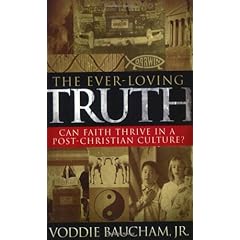
Voddie Bauchum, a post-graduate from Oxford in Cultural Apologetics, wrote this great book on our postmodern culture. The Ever-Loving Truth is a response to non-absolutists. These postmodern, non-absolutists basically believe that there are no absolutes. You may be surprised, but a lot of people think this way. There are many in our culture who believe that all faiths and beliefs are people's own prerogative. So if you're a Buddhist and I'm a Christian, then the postmodern reaction to that would be to say, "that's fine, you be you and I'll be me".
Christians, explains Dr. Bauchum, are not following the gospel in conforming to this cultural belief system. He explains that God Himself is an absolute in the highest sense. There is only one God. He then argues that non-absolutists shoot themselves in the foot with their own argument because it is tantamount to saying: It is absolutely true that there are no absolute truths! So, if truths are only valid if it is absolute, then should we not seek the "ever-loving truth"?
Dr. Bauchum also explains something that I find remarkable. Without giving too much away, he explains that we Christians can do three things to spread the absolute truth of the gospel, we can: (1) immerse ourselves in the culture, (2) isolate ourselves from the culture, or (3) insulate ourselves in and from the culture. If you read the book, he explains very cogently that all of these strategies of spreading the gospel have dangers, depending on the faith focus of an individual. So, he says that there is a fourth option: "infiltrate and invade".
I love this phrase "infiltrate and invade" because it means that we are actively spreading the gospel by humbly-covertly infiltrating people's lives, and coherently-unabashedly invading people's lives. We are at war, and though we must be patient-kind-faithful (Galatians 5:22), we worship God first by proclaiming the gospel in any and every way.
Read this book. It's worth it. Amazon.ca
Friday, April 13, 2007
Contextualizing or Compromising?
Voddie Bauchum writes in "The Ever-Loving Truth":
If you are contexualizing, that's great! This means that you are empathizing and accommodating others without compromising the gospel. This is exactly what Paul tells us to do in Romans 14:13,
"There is a difference between contextualization and compromise. Using goat's milk for communion in a culture is contextualization; sacrificing the goat is compromise. Having Saturday night services because we have run out of room in all four Sunday services is contextualization; having a Saturday night service to accomodate and/or appease people who are "too busy" on Sunday is compromise."
If you are contexualizing, that's great! This means that you are empathizing and accommodating others without compromising the gospel. This is exactly what Paul tells us to do in Romans 14:13,
Therefore let us not pass judgment on one another any longer, but rather decide never to put a stumbling block or hindrance in the way of a brother.
If you are compromising, that's bad. Essentially, you are stealing from God what He deserves. That is, namely, your all and everything. When you put your wants and your needs before God, then you steal from God by denying Him; as Proverbs 3:30 says,
How do you compromise with the living God? Do you ask him to meet you half way? When you say, "I want my non-Christian girlfriend/boyfriend before you work your sovereign grace on her/him", are you not putting yourself first?
Do not compromise your faith.
Don't do it for my sake, though I hope that this causes you to move and take action. Do it for the glory of God.
If you are compromising, that's bad. Essentially, you are stealing from God what He deserves. That is, namely, your all and everything. When you put your wants and your needs before God, then you steal from God by denying Him; as Proverbs 3:30 says,
lest I be full and deny you
and say, “Who is the Lord?”
or lest I be poor and steal
and profane the name of my God.
and say, “Who is the Lord?”
or lest I be poor and steal
and profane the name of my God.
How do you compromise with the living God? Do you ask him to meet you half way? When you say, "I want my non-Christian girlfriend/boyfriend before you work your sovereign grace on her/him", are you not putting yourself first?
Do not compromise your faith.
Don't do it for my sake, though I hope that this causes you to move and take action. Do it for the glory of God.

Tuesday, April 10, 2007
We Work With You For Your Joy
There are people who God has blessed to speak with passion and authority. When I watched this little video made by someone at Southern Baptist Theological Seminary, I was thinking about the leaders at faith church. May this be true in all of our hearts as we serve our GREAT LORD.
By the way, the Bible passage that Dr. Piper refers to in the video is 2 Corinthians 1:24-2:4.
Monday, April 09, 2007
Third Day
There has been confusion on when Jesus actually resurrected. I grew up being taught that Jesus died on Friday, and Monday was the day he was resurrected, hence "Easter Monday". Then why do we call Sunday, "Resurrection Sunday"?
Well, as it turns out, Jesus did rise again on Sunday!
Allow me to explain:
Paul says in 1 Corinthians 15:4,
We know that Jesus died and was buried the day before the Sabbath (which Jews considered to be on Saturday) from Mark 15:42,
Therefore, if Jesus was buried on Friday (the day before the Sabbath), shouldn't the day of resurrection be on Monday, which would be exactly three days after?
The bible tells us no! Jesus was raised the day after the Sabbath, which is on Sunday. We know this because it says in Matthew 28:1-10,
So, the gospels say that Jesus died on Friday and was raised on Sunday. On the other hand, Paul says that he was raised in three days, just like the prophecies in Hosea 6:2,
Is there a contradiction? By no means!
You see, first-century Jews understood the word "day" differently from us. A day started at 6pm, and ended at the same time the next day. Plus, a day doesn't have to mean a full night and a full day for a Jew. So if a person was sleeping from 5 pm until 6pm the next day, he would have been sleeping for two days. This is because even 1 hour is considered a full day if it happens outside of 24 hours. Hence, 25 hours would be two days.
Jesus died on the 9th hour (Matthew 27:46), which is equivalent to 3pm. That means that from 3pm to 6pm, Jesus was dead for one day. Then from 6pm on Friday to 6pm on Saturday, he was dead for two days. Then from 6pm on Saturday to the morning of Sunday, Jesus was dead for three days.
Therefore, there are no inconsistencies between the gospels, Paul, and the prophecies! It is true that Jesus died on Friday and was raised on Sunday! It is true that Jesus was raised in three days! It is true that this is a fulfillment of the Old Testament prophecies!
_______________________________________________________
What's the point of knowing this?
1. For our faith. Instead of being shaken by passages that seem to contradict one another, I would encourage all to prayerfully seek to understand the gospel rather than outright dismiss it.
2. Apologetics, or to defend our faith. The unknowing reader can easily come across this supposed contradiction and argue against the truth of the gospel of Jesus Christ. In sharing the gospel, Christians knowing the details about Jesus' death can explain the gospel in all its fullness and display their devotion to knowing Christ.
3. For the supremacy of Christ in our lives! The gospel is God, so seek comfort and rest and peace in it. There is nothing sweeter than the love of God, who sent His son to die for our sins, thereby reconciling us to God. This message is central to our lives, and is even lovelier knowing that there is consistency in the gospel.
I hope this message brings you joy!
Well, as it turns out, Jesus did rise again on Sunday!
Allow me to explain:
Paul says in 1 Corinthians 15:4,
"that [Jesus] he was buried, that he was raised on the third day in accordance with the Scriptures"
We know that Jesus died and was buried the day before the Sabbath (which Jews considered to be on Saturday) from Mark 15:42,
"And when evening had come, since it was the day of Preparation, that is, the day before the Sabbath"
Therefore, if Jesus was buried on Friday (the day before the Sabbath), shouldn't the day of resurrection be on Monday, which would be exactly three days after?
The bible tells us no! Jesus was raised the day after the Sabbath, which is on Sunday. We know this because it says in Matthew 28:1-10,
"Now after the Sabbath, toward the dawn of the first day of the week, Mary Magdalene and the other Mary went to see the tomb..."
So, the gospels say that Jesus died on Friday and was raised on Sunday. On the other hand, Paul says that he was raised in three days, just like the prophecies in Hosea 6:2,
"After two days he will revive us;
on the third day he will raise us up,
that we may live before him."
on the third day he will raise us up,
that we may live before him."
Is there a contradiction? By no means!
You see, first-century Jews understood the word "day" differently from us. A day started at 6pm, and ended at the same time the next day. Plus, a day doesn't have to mean a full night and a full day for a Jew. So if a person was sleeping from 5 pm until 6pm the next day, he would have been sleeping for two days. This is because even 1 hour is considered a full day if it happens outside of 24 hours. Hence, 25 hours would be two days.
Jesus died on the 9th hour (Matthew 27:46), which is equivalent to 3pm. That means that from 3pm to 6pm, Jesus was dead for one day. Then from 6pm on Friday to 6pm on Saturday, he was dead for two days. Then from 6pm on Saturday to the morning of Sunday, Jesus was dead for three days.
Therefore, there are no inconsistencies between the gospels, Paul, and the prophecies! It is true that Jesus died on Friday and was raised on Sunday! It is true that Jesus was raised in three days! It is true that this is a fulfillment of the Old Testament prophecies!
_______________________________________________________
What's the point of knowing this?
1. For our faith. Instead of being shaken by passages that seem to contradict one another, I would encourage all to prayerfully seek to understand the gospel rather than outright dismiss it.
2. Apologetics, or to defend our faith. The unknowing reader can easily come across this supposed contradiction and argue against the truth of the gospel of Jesus Christ. In sharing the gospel, Christians knowing the details about Jesus' death can explain the gospel in all its fullness and display their devotion to knowing Christ.
3. For the supremacy of Christ in our lives! The gospel is God, so seek comfort and rest and peace in it. There is nothing sweeter than the love of God, who sent His son to die for our sins, thereby reconciling us to God. This message is central to our lives, and is even lovelier knowing that there is consistency in the gospel.
I hope this message brings you joy!
Saturday, April 07, 2007
Why was God on a Tree? – Reconciliation
Romans 5:10-11 (2 Corinthians 5:18-20)
(Message given at Faith Church on April 1, 2007, 1:30pm)
For if while we were enemies we were reconciled to God by the death of his Son, much more, now that we are reconciled, shall we be saved by his life. More than that, we also rejoice in God through our Lord Jesus Christ, through whom we have now received reconciliation. Romans 5:10-11 (ESV)
Today, we focus on who are we reconciled to.
Reconciliation is about resolving conflict between two people and bringing them back into harmony with one another. Another way of saying it would be to restore peace by removing the conflict.
With God and us, there is sin and wrath that is against us. However, what we have been looking at in the last several weeks is that through Jesus’ substitutionary atonement, and our faith in Jesus, our sins are not counted against us anymore.
In Christ God was reconciling the world to himself, not counting their trespasses against them … 2 Corinthians 5:19 (ESV)
There is now for the believer, reconciliation. We are going to look at this doctrine of reconciliation little bit more closely and then consider some applications of this doctrine to our lives.
Let’s look at it by first saying, We were reconciled to God …
1. While we were enemies. (Vs. 10a) Paul says the same thing in couple of different ways.
For while we were still weak, at the right time Christ died for the ungodly. Romans 5:6 (ESV)
But God shows his love for us in that while we were still sinners, Christ died for us. Romans 5:8 (ESV)
There was enmity with God. Overcoming enmity is to take away the cause of the quarrel. Something has to change. God Does not change in nature but does change in that He needs to stop being against me (His enemy). Having an enemy is one thing but being an enemy of God.
No NT passage talks about reconciling God to man.
(Message given at Faith Church on April 1, 2007, 1:30pm)
For if while we were enemies we were reconciled to God by the death of his Son, much more, now that we are reconciled, shall we be saved by his life. More than that, we also rejoice in God through our Lord Jesus Christ, through whom we have now received reconciliation. Romans 5:10-11 (ESV)
Today, we focus on who are we reconciled to.
Reconciliation is about resolving conflict between two people and bringing them back into harmony with one another. Another way of saying it would be to restore peace by removing the conflict.
With God and us, there is sin and wrath that is against us. However, what we have been looking at in the last several weeks is that through Jesus’ substitutionary atonement, and our faith in Jesus, our sins are not counted against us anymore.
In Christ God was reconciling the world to himself, not counting their trespasses against them … 2 Corinthians 5:19 (ESV)
There is now for the believer, reconciliation. We are going to look at this doctrine of reconciliation little bit more closely and then consider some applications of this doctrine to our lives.
Let’s look at it by first saying, We were reconciled to God …
1. While we were enemies. (Vs. 10a) Paul says the same thing in couple of different ways.
For while we were still weak, at the right time Christ died for the ungodly. Romans 5:6 (ESV)
But God shows his love for us in that while we were still sinners, Christ died for us. Romans 5:8 (ESV)
There was enmity with God. Overcoming enmity is to take away the cause of the quarrel. Something has to change. God Does not change in nature but does change in that He needs to stop being against me (His enemy). Having an enemy is one thing but being an enemy of God.
No NT passage talks about reconciling God to man.
It is never said that God is reconciled. God is propitiated, the sinner reconciled.” – C.I. Scofield
We were reconciled to God while we were enemies …
2. By the death of his Son. (Vs. 10b)
Notice with me that God took the initiative.
This is totally the opposite of what would seem right and normal. If I caused the rupture by wrongdoing, it would incumbent on me to reconcile. But the gospel says something very different.
Our sin caused a rupture in the relationship with God and so we need to be reconciled with God but He did something about it. Paul says in 2 Corinthians 5.
All this is from God, who through Christ reconciled us to himself … 2 Corinthians 5:18a (ESV)
We were reconciled to God while we were enemies by the death of His Son …
3. To rejoice in God. (Vs. 11)
All that we have talked about before must imply reconciliation or they are not good news. Are you in love with God or are you in love with God’s gifts.
When I say that God Is the Gospel I mean that the highest, best, final, decisive good of the gospel, without which no other gifts would be good, is the glory of God in the face of Christ revealed for our everlasting enjoyment. The saving love of God is God’s commitment to do everything necessary to enthrall us with what is most deeply and durably satisfying, namely himself. Since we are sinners and have no right and no desire to be enthralled with God, therefore God’s love enacted a plan of redemption to provide that right and that desire. The supreme demonstration of God’s love was the sending of his Son to die for our sins and to rise again so that sinners might have the right to approach God and might have the pleasure of his presence forever. …
If you could have heaven, with no sickness, and with all the friends you ever had on earth, and all the food you ever liked, and all the leisure activities you ever enjoyed, and all the natural beauties you ever saw, all the physical pleasures you ever tasted, and no human conflict or any natural disasters, could you be satisfied with heaven, if Christ were not there? Dr. John Piper
For Christ also suffered once for sins, the righteous for the unrighteous, that he might bring us to God, being put to death in the flesh but made alive in the spirit, 1 Peter 3:18 (ESV)
We were reconciled to God while we were enemies by the death of His Son to rejoice in God through our Lord Jesus Christ.
4. Therefore three things.
a) Be reconciled to God.
We implore you on behalf of Christ, be reconciled to God. 2 Corinthians 5:20b (ESV)
b) Be reconciled to one another.
For he himself is our peace, who has made us both one and has broken down in his flesh the dividing wall of hostility by abolishing the law of commandments and ordinances, that he might create in himself one new man in place of the two, so making peace, and might reconcile us both to God in one body through the cross, thereby killing the hostility. And he came and preached peace to you who were far off and peace to those who were near. For through him we both have access in one Spirit to the Father. Ephesians 2:14-18 (ESV)
“Conflict always provides an opportunity to glorify God, that is, to bring him praise and honor by showing who he is, what he is like, and what he is doing. The best way to glorify God in the midst of conflict is to depend on and draw attention to his grace, that is, the undeserved love, mercy, forgiveness, strength, and wisdom he gives to us through Jesus Christ.” – Ken Sande (The Peacemaker)
Be reconciled to one another by...
i) Trusting God’s wisdom.
ii) Obeying God’s commands.
iii) Imitating God’s character.
iv) Acknowledging God’s grace.
c) Be a minister of reconciliation.
All this is from God, who through Christ reconciled us to himself and gave us the ministry of reconciliation; that is, in Christ God was reconciling the world to himself, not counting their trespasses against them, and entrusting to us the message of reconciliation. Therefore, we are ambassadors for Christ, God making his appeal through us. We implore you on behalf of Christ, be reconciled to God. 2 Corinthians 5:18-20 (ESV)
If you are reconciled, it is not that you might be a minister of reconciliation but it is that you are. You have been given this incredible calling in life. How is this lived out?
In your family, at you work / school, in the church, and with other people God brings to you, we are called to participate in God making His appeal through us.
Through God’s grace, may we resolve to live that way.
Subscribe to:
Comments (Atom)